Passive Aggression - A High School Social Skills Activity

You are here:

Social Skills / Activities / Passive Aggression

Passive Aggression Worksheet


Watch the video to learn more
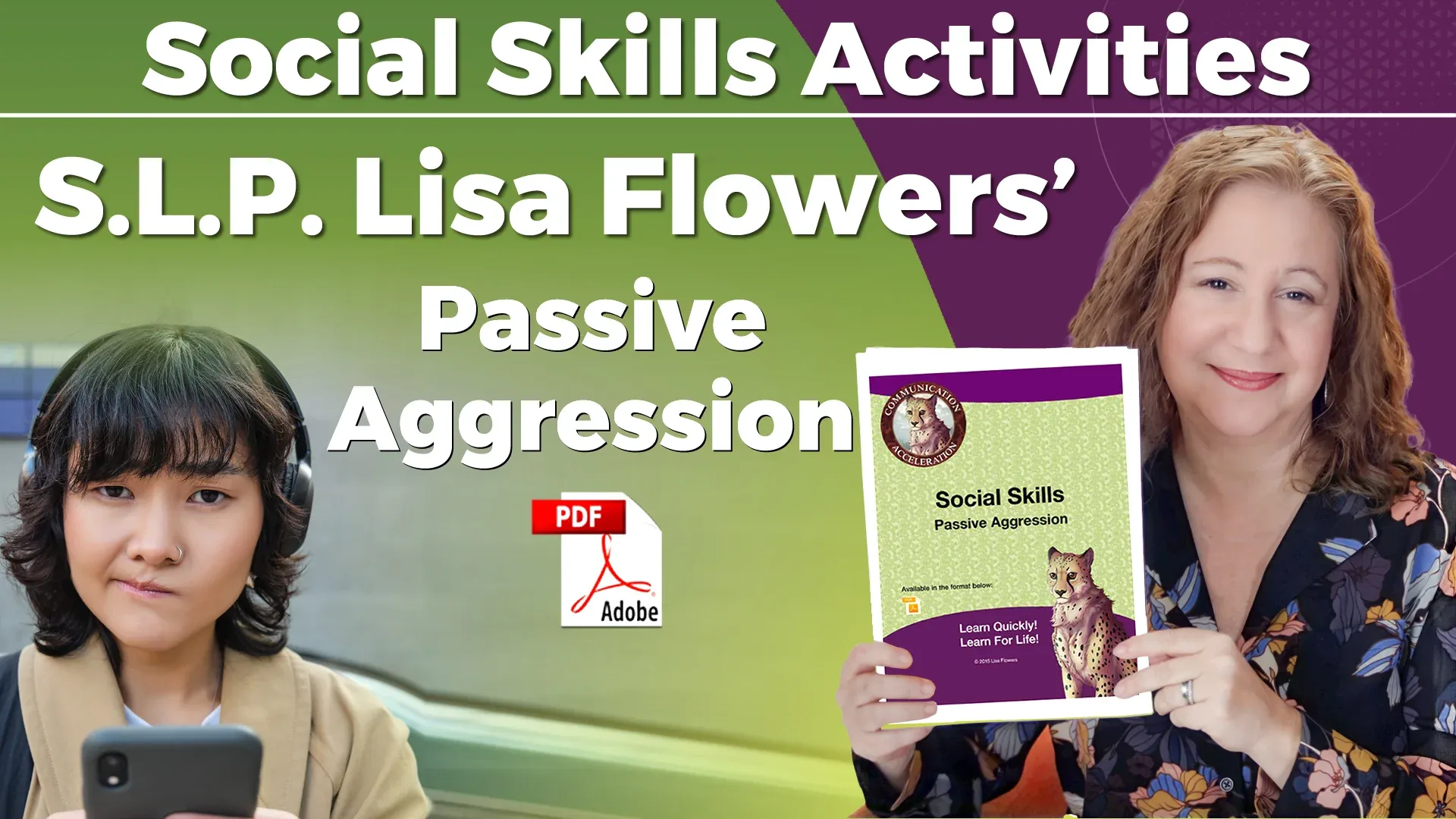
Passive Aggression Worksheet A High School Social Skills Activity Video
Play Worksheet Video

Click here for video transcription and ADA compliant audio for the video above

Passive Aggression

This activity teaches our vulnerable students to identify passive aggressive statements or actions, and to stand up for themselves.

View Sample PDF

Social Skills Worksheet Passive Aggression Worksheet by Speech Language Pathologist Lisa Flowers

Passive Aggression Worksheet

This resource addresses how to handle passive aggression from others, teaching students to consider others' perspectives to establish what motivates passive-aggressive behaviors and statements, how to stand up for themselves, and how different contexts can yield different responses.

Passive aggression from others is often quite difficult to deal with. It's important to help students understand both how to identify it and how to deal with it, as behaviors and comments of that nature are hostile and our students don't deserve hostility. We typically begin by discussing the term: “passive” referencing an individual wishing to engage in belligerent behavior without being held accountable; and “aggressive”, which references active hostility. Students are supplied with examples of back-handed compliments like “I love your top, you don't look as fat in it”. For each example offered, we discuss the aggression and how the speaker attempts to mask the hostility with passivity. Subsequently, we address how to react to the behavior or comment, encouraging the students to hold the speaker accountable for their hostility to both stand up for themselves and help curb the speaker's passive-aggressive behaviors moving forward.

Search Another Way

Time Sensitivity
Time Sensitivity

As a teacher, this social skills activity involves students engaging in a written discussion about being mindful of a listener's time limit, followed by rolling dice to determine a hypothetical content and context for their speech. Students then estimate an appropriate time frame and practice delivering their assigned content within that timeframe, aiming to increase their awareness of listener's needs and improve their ability to effectively manage the time they use to convey their message.

How to Teach Empathy in the Classroom in PDF
Entering Conversations

This conversational skills handout outlines the essential behaviors for entering ongoing conversations, encompassing observation, physical proximity, timing, commenting/questioning, determination of acceptance, and exit strategies. Designed for individuals on the autism spectrum, the handout serves as a valuable tool for discussion and role-play activities, fostering the enhancement of conversational skills and understanding of social dynamics.

Perspective Taking Worksheets in PDF: Polite Wording
Polite Wording

This practical worksheet focuses on developing listener presupposition and perspective-taking abilities. It initiates with a written discussion emphasizing the significance of considering one's listener and modifying requests and comments for optimal outcomes. The worksheet includes examples of polite phrases to incorporate into requests and opinion statements, followed by multiple sentences for students to practice incorporating these phrases, enabling them to refine their language use while being mindful of their audience.

Perspective Taking High School Worksheet
Tact

This perspective-taking handout is designed to foster empathy, particularly for individuals on the autism spectrum who may face challenges in these areas. By presenting twenty-one statements containing tactless sentiments such as bragging, offensiveness, prejudice, inappropriateness, and over-generalization, this handout prompts extensive discussions about understanding others' perspectives and feelings. The inclusion of an answer key provides guidance throughout the process.

Autism Communication Strategies Activities and Worksheets in PDF
Speaking to Different Communicative Partners

Developing theory of mind encompasses not only understanding others' perspectives but also adjusting one's own behavior accordingly, making it crucial in social emotional learning. These printable worksheets specifically cater to individuals on the autism spectrum, aiding in the improvement of their ability to modify their speech based on the intended listener. Through a process that involves answering six questions in writing, revisiting and selecting relevant information based on the recipient, and responding to subsequent questions for specific receivers, these worksheets facilitate extended discussions that delve into the reasoning behind the choices made.

Perspective Taking Activities for Autism in PDF
Perspective Taking

This is a great assignment to give following the Developing Empathy and Conversations activity. It begins with an extensive discussion on helping individuals on the autism spectrum develop perspective taking and empathy, including some of my professional experiences. A homework handout follows, requiring students to observe real-life social interactions and to “put themselves in another's shoes”. The handout ends by asking what actions the student could have taken to improve a social situation for a person in distress, thereby tying observation and interpretation to troubleshooting and taking action.

How to Teach Empathy in the Classroom in PDF
Developing Empathy

As a teacher who focuses on social-emotional learning, this activity holds a special place for me as it effectively promotes perspective-taking and empathy through engaging conversational practice. It begins with a thorough discussion highlighting the significance of empathy, followed by detailed explanations of terms such as "spatial inclusion", "conversational participation", "social distress", and "mood". Students then have the opportunity to enhance their social observation and perspective-taking skills using the session handout, and further generalize their learning by utilizing the "homework" handout for real-world practice.

Writing a Letter of Complaint Exercise in PDF
Writing a Complaint Letter

This unique activity combines writing and social skills, focusing on perspective-taking and the crucial ability to modify language to create targeted impressions. Students engage in crafting complaint letters, considering both content and wording to convey honest and reasonable impressions, enhancing their perspective-taking skills. This practical and favorite activity promotes high-level life skills while keeping the reader in mind.

Conversation Turn Taking Activities
Elaboration in Conversation

In this favorite activity, students develop perspective-taking skills by crafting complaint letters, considering content and wording to convey targeted impressions. It combines writing and social skills, addressing the importance of modifying language and keeping the reader in mind. Students notably improve their perspective-taking abilities while engaging in this practical and engaging activity.

Kinesics - Interest vs. Disinterest

In this favorite activity, students develop perspective-taking skills by crafting complaint letters, considering content and wording to convey targeted impressions. It combines writing and social skills, addressing the importance of modifying language and keeping the reader in mind. Students notably improve their perspective-taking abilities while engaging in this practical and engaging activity.

Social Skills Activities - Set The Scene
Set The Scene

Narratives: Set the Scene is a valuable tool for teaching individuals with attention deficit disorders, impaired executive skills functioning, or on the autism spectrum how to effectively share organized and comprehensive stories that engage their communicative partners. It addresses the challenges my students with A.S.D. or attention deficit disorders face in providing relevant information when asked simple questions about their experiences. Being a Good Conversationalist.

Being a Good Conversationalist

Improving conversational skills is beneficial not only for individuals on the autism spectrum but for everyone. Many of us encounter individuals in our lives who struggle with monopolizing conversations, interrupting frequently, or sharing lengthy stories with excessive detail. Unfortunately, it can be challenging to address these behaviors comfortably. As a social emotional learning teacher, I value the opportunity to guide my students in developing social niceties and conversation skills. We engage in discussions about each aspect of Being a Good Conversationalist and practice through various exercises, often focusing on one aspect at a time. For further information and guidance, please refer to the therapeutic notes provided. Together, we strive to foster positive and engaging interactions in both personal and professional settings.

Choosing Conversation Topics

When discussing social skills with my students, one of the areas they often express a desire to work on is choosing conversation topics. I emphasize that a good topic should meet three criteria: it should be interesting to all participants, shared by everyone involved, and appropriate for the conversation. While commonality is usually important, there are exceptions when someone is sharing a story or providing information. Similarly, appropriateness can vary depending on the individuals involved.

Interviewing Others
Interviewing Others

In the Interviewing Others activity, I emphasize the importance of genuine interest in others for meaningful conversations. Students interview staff members, high school seniors, or family members to practice conversational skills, such as responding with comments and follow-up questions. This skill extends conversations and demonstrates active listening, making their partners feel heard. The activity includes interview forms and therapeutic intervention notes.

Post-Conversation Questionnaire

Following conversations, I utilize a post-conversation questionnaire to enhance my students' conversational skills. This questionnaire encourages curiosity about their partner, identifying impressions, and analyzing non-verbal behaviors. It aids students in focusing their attention on one person and preparing them to observe specific aspects during conversations. As a speech language pathologist, I understand the importance of naturalistic conversations while targeting skills such as topic shifting, turn taking, and non-verbal interpretation.

Social Skills worksheet tone of voice by lisa flowers
Tone of Voice

When considering non-verbal communication, it's important to acknowledge the role of tone of voice in expressing emotions and intentions. Tone of voice can be just as significant as words, and misinterpretations can occur in written communication. To address challenges faced by individuals on the autism spectrum, I've developed an activity that focuses on interpreting and using tone of voice effectively. Additionally, Tone of Voice can serve as an evaluation tool, helping us better understand students' intentions when their tone does not match their message.

Interpreting Non-Verbal Communication Homework

As individuals on the autism spectrum often struggle with interpreting non-verbal communication, I assign homework to my students that focuses on observing and interpreting non-verbal behaviors. We explore facial expressions, body language, and tone of voice through various activities such as analyzing videos without sound and using resources like Tone of Voice and Kinesics: Interest vs. Disinterest. This homework task challenges students to interpret others' perspectives from non-verbal cues and emphasizes the importance of responding empathetically to others' feelings.

Impressions from Appearances

In the Impressions from Appearances activity, I help my students understand that people often judge based on appearances, even though it may not be fair or accurate. We take turns being judged and fill out a form together, focusing on controllable appearance features like clothing and makeup. I emphasize that the impressions derived from appearances are often mistaken stereotypes and encourage students to reflect on the accuracy of these impressions.

Attaining Targeted Impressions

When teaching social emotional learning, it's important to engage students in activities that promote empathy and perspective taking. An effective activity involves students reflecting on the impressions they want to give in different situations and how to achieve them. By engaging in these activities, students develop communication skills, build stronger connections, and contribute to a more inclusive community.

Impressions and Altruism

As a teacher of social emotional learning, I emphasize the importance of altruism to my students. I explain that being kind is not only the right thing to do, but it also benefits them personally. It leads to positive impressions, fostering relationships, and professional opportunities. In the Impressions and Altruism activity, students consider both their own and the other person's feelings in different social interactions, aiming to find mutually beneficial outcomes. This activity encourages empathy and understanding in various contexts, including job interviews and healthcare settings.

Understanding Others Reference Sheet

As a teacher of social emotional learning, I recognized the challenges my students on the autism spectrum face in understanding others' feelings and perceptions. To support their perspective-taking skills, I created an Understanding Others Reference Sheet. This resource provides common feelings and perceptions during social interactions, empowering students with valuable knowledge they may not instinctively possess. By having this reference sheet, students can enhance their ability to identify and predict others' perspectives, benefiting their overall social understanding and interactions.

Greetings Worksheet
Greetings Worksheet

As a teacher of social emotional learning, I understand that individuals on the autism spectrum may struggle with social customs, including greetings. To support their social awareness, I created a Greetings Worksheet. This resource helps students explore different greeting choices and the appropriate contexts in which to use them. By using the worksheet alongside discussion, students can become more familiar with social norms and develop their greeting skills. This activity promotes understanding of social interactions and enhances students' ability to navigate social situations effectively.

Getting Someone's Attention

This activity allows me to observe my students' social interactions and identify areas for improvement. One skill that requires more attention than initially thought is getting someone's attention. I have my students practice this skill by discussing various factors and scenarios, such as open or closed doors, phone conversations, or in-person interactions. To assess their progress, I provide a form for students to deliver to specific staff members and gather feedback. This activity helps students develop their social skills and receive direct feedback for growth.

Restaurant Etiquette

In teaching social emotional learning, I find that addressing restaurant etiquette is important for adolescents who may have limited experience in this area. Dining out involves social interactions with servers and other staff, requiring perspective taking skills. I emphasize the impact of our behaviors on others, discussing topics like the importance of making reservations, avoiding late arrivals, and practicing politeness. By understanding these social dynamics, students can navigate restaurant settings more effectively.

Answering Job Interview Questions

In my social emotional learning class, I utilize a worksheet that offers comprehensive guidance on answering the most frequently asked job interview questions. It emphasizes the importance of listener presupposition, prompting students to consider the perspective of the interviewer. By focusing on the desired impressions they want to convey, students learn how to craft effective answers. We engage in role-play exercises to practice these skills after reviewing the worksheet collaboratively.

Passive Aggression
Passive Aggression

In my social emotional learning class, we explore the concept of passive aggression and how to effectively address it. We discuss examples of disguised insults and examine the underlying hostility behind them. Students learn strategies for handling such comments or behaviors, including calmly confronting the other person. While standing up for themselves is encouraged, students are also empowered to choose the approach that works best for them in different situations.

Passive Aggression
Social Skills Activities Packet

The Social Skills Activities Packet is a comprehensive collection of 28 resources designed to support professionals in promoting social skill development. Through materials like the Communication Skills Questionnaire and activities such as Being a Good Conversationalist and Entering Conversations, students and clients can enhance their conversational abilities.

Get Social Skills
Packet

Tact

A collection of 28 social skills worksheets and activities that cover conversation skills, kinesics, perspective taking, development of empathy, and real-world communication.

$19

Buy Now!

Get 52 Lessons & Activities

Tact

A collection of 52 language and communication worksheets and activities that cover a plethora of reading comprehension, writing, grammar, and social communication skills.

$29

Buy Now!

Get these social skills activities and more to help teach children with autism.