See the audio transcription below:
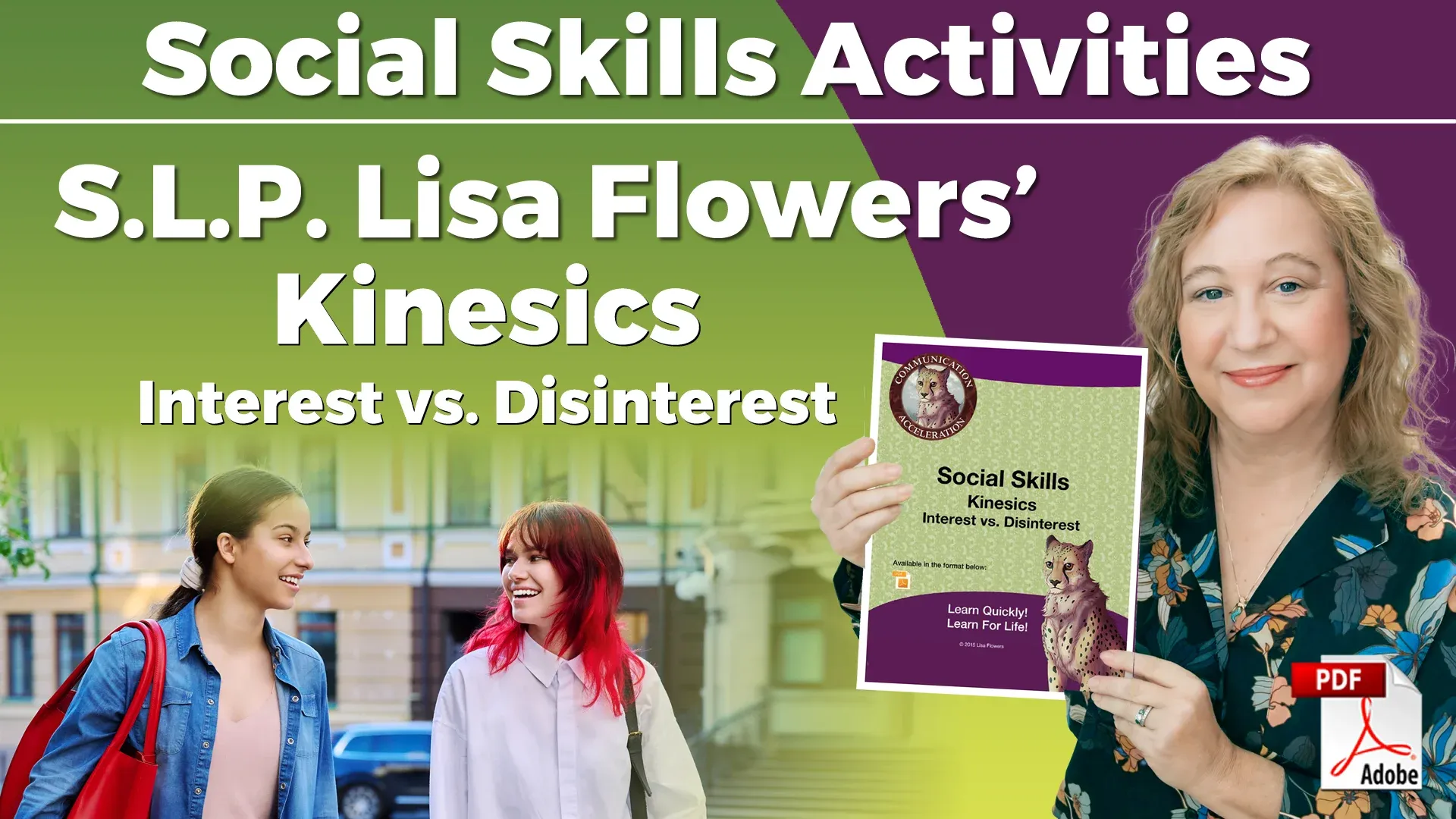
Welcome to my material Kinesics: Interest vs. Disinterest. It teaches students how to read nonverbal clues to determine if their listener is interested in the conversation. Check out this excerpt from the training video I did for the New York City Department of Education. Which brings us to Kinesics: Interest vs. Disinterest. I created this activity because of a real need my students had and also, you'll see it just out in the world, people who may keep talking to you when you're really trying to give signs that you don't have time to talk, or you're not interested in talking. I've seen so many students that go on and on with long stories, and really don't pick up on all the nonverbal clues that the person they're talking to doesn't have the time or just isn't interested. What I do is I have a checklist, and the checklist makes nonverbal communication behaviors tangible, different behaviors for showing when someone is interested, right? They make eye contact, they're talking back to you, their body is turned towards you, they have an open posture and so on. Versus signs of disinterest: little or no eye contact, maybe a closed body posture, no smiling, one word responses to questions. And what I want my students to do is get used to looking for those signs. So, I don't want them to have a conversation at the same time they're looking, because it's too many things to do at once. So, I usually start off by maybe we'll look at a TV show with the volume turned off, and make checklists, watch one person in particular in the show and check off their behaviors, or a reality TV show. And then I'll take them around the school and I'll go to one of my staff members and have a little conversation with them while my student is standing there with the checklist to make sure they see behavioral signs of interest vs. disinterest.
Now when I do this I have to sometimes tell my coworkers ahead of time to pretend they don't want to talk to me because my coworkers tend to be so kind, and even if they didn't have time or didn't want to talk to me they'd pretend they did want to talk to me, and then the students would never get the opportunity to observe signs of disinterest. But if you're going to do this, you have to be careful that you pick a coworker who's a good actor, because I will never forget one time I had my supervisor be the actor who's not interested in talking to me, and she overacted so badly it was terrible. I mean I just wanted her eye contact to be a little fleeting, and maybe seem a little disinterested, but she basically ignored me and just was working on her filing cabinet and looked angry. So, make sure you pick a coworker who's a good actor. Thanks for reviewing my description of Kinesics: Interest vs. Disinterest. If you like what you've seen here, please click and subscribe to my channel. I'm not exactly sure what that means, but my web guy told me it's a thing.
Get Great Social Skills Worksheets to add to your Social Emotional Learning Curriculum!